
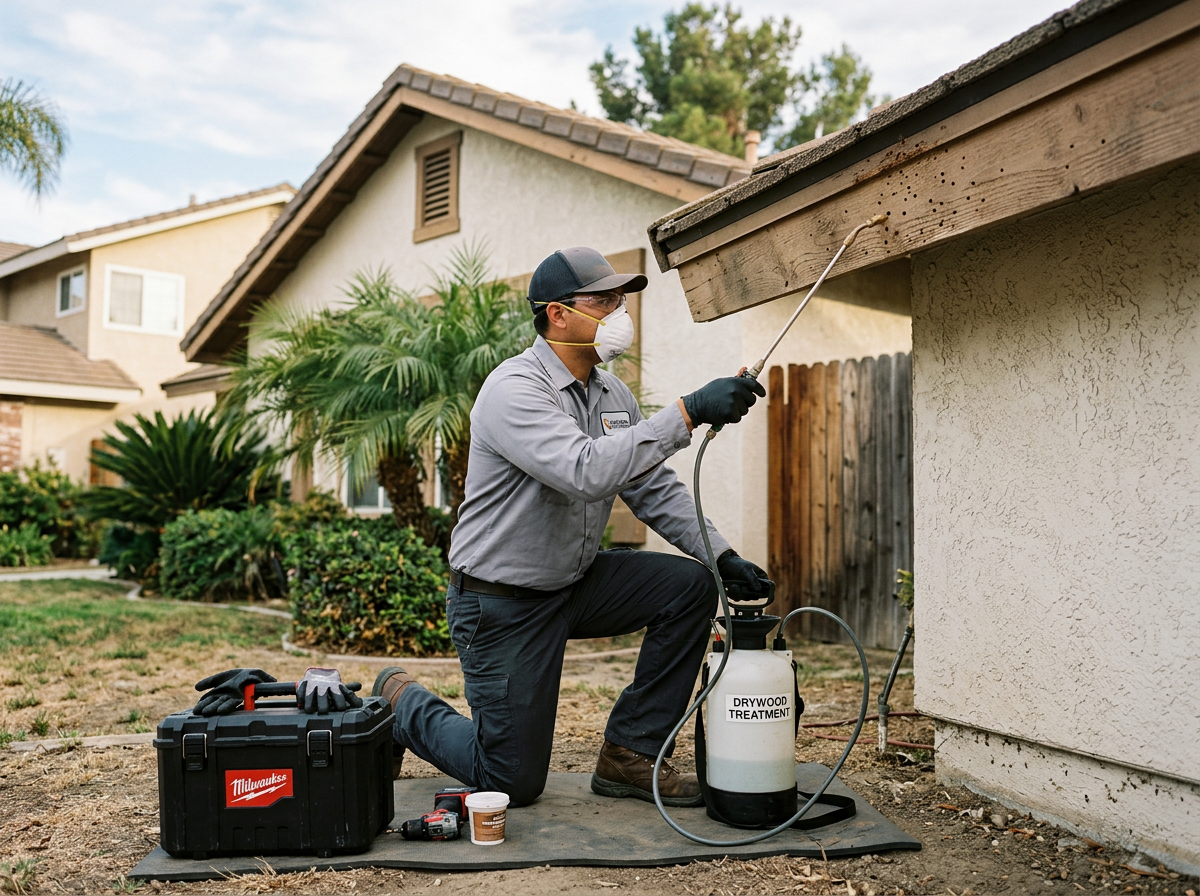
Drywood termites remain inside structural timbers without touching soil, producing small hexagonal frass pellets that collect beneath kick-out holes. In Tehachapi foothill homes these signs often appear on baseboards, window frames and exposed rafters in crawl spaces or attics where old-growth lumber provides long-term food sources. Because colonies stay hidden, damage can spread through galleries that follow the grain before any pellets are noticed on floors or sills.
Treatment begins with mapping every accessible member to locate active galleries, then injecting borate dust or foam directly into entry points so the material reaches the colony. Local fumigation follows when multiple joists or wall studs show widespread activity that spot methods cannot reach. Success depends on treating every exit hole and gallery entrance; any missed section allows surviving termites to continue feeding and produce new frass within months.
Drywood Termite Control Near You — Choose Your City
Every city below has its own local Drywood Termite Control page with coverage details.
Mono County
Butte County
Kern
Fresno County
Plumas County
Kern County
Yuba County
Inyo County
Placer County
Sutter
Tuolumne County
Tulare
Calaveras County
Mariposa
Alameda
Mariposa County
Amador County
Nevada County
Sierra County
Plumas
Riverside
San Bernardino County
Sonoma
San Diego County
Riverside County
Sonoma County
Marin County
Glenn County
San Bernardino
Los Angeles County
San Diego
Tulare County
Mendocino
Yolo County
Monterey County
Madera County
Treatments fail when inspectors mistake drywood signs for subterranean mud tubes or when only visible holes receive product while deeper galleries remain untouched. Whole-structure tenting becomes necessary once activity spans more than isolated members or when the home layout prevents safe local gas application. Tehachapi cabins left vacant for extended periods frequently reach this point because no one notices accumulating pellets until escrow inspections occur.
When Local Treatment Is Not Enough
Whole-structure fumigation is required once galleries extend through multiple connected timbers or when kick-out holes appear on both interior and exterior faces of load-bearing walls. In these cases localized work leaves untreated sections that continue to produce frass and weaken members over time.
Technician insight
In Tehachapi the thing that catches most people out with Drywood Termite Control is the old-growth timber in foothill cabins that sit empty for months, allowing galleries to expand undetected until frass appears on the floor during a pre-sale walk-through.
Tehachapi Cabin Floor Joist Infestation
Homeowner noticed small pellet piles near baseboards after returning to a vacant cabin. Inspection located active galleries running through multiple floor joists. Borate dust was injected into every kick-out hole and foam was used on deeper sections; local fumigation treated two connected wall studs. No new frass appeared on the follow-up visit.
Drywood Termite Control Services We Offer
✓Frass and Kick-Out Hole Inspection
Technicians examine every accessible wood surface for frass piles and active kick-out holes to confirm drywood presence before any treatment begins.
✓Borate and Foam Spot Treatment
Borate dust or expanding foam is injected into identified galleries and exit holes to reach colonies inside individual joists, studs and rafters.
✓Local Fumigation for Drywood Termites
Isolated sections of a structure receive targeted gas treatment when spot methods cannot reach all active galleries within a single member or room.
✓Whole-Structure Fumigation Referral Assessment
When drywood activity spans too many connected timbers, the property is evaluated for full tenting and referred to a licensed fumigation crew.
✓Post-Treatment Gallery Monitoring
Follow-up visits check previously treated members for new frass or reopened kick-out holes to verify that colonies have been eliminated.
How it works
- 1
On-Site Wood Member Inspection
Every accessible joist, stud, sill and rafter is examined for frass, kick-out holes and gallery entry points.
- 2
Species Confirmation and Mapping
Frass samples and hole patterns confirm drywood activity and every active location is marked for treatment.
- 3
Targeted Product Application
Borate dust or foam is placed directly into galleries and exit holes; local fumigation follows when needed.
- 4
Clearance and Follow-Up Check
Treated areas are reinspected after the required interval to confirm no new frass appears.
Pricing
Scope and pricing are set only after an inspection identifies the extent of galleries and number of members requiring treatment; call to schedule.