
California properties face two distinct termite threats that require opposite approaches. Drywood termites remain inside structural wood with no soil contact, producing frass that appears as tiny hexagonal pellets beneath kick-out holes on coast and southern homes. Subterranean termites need constant soil moisture and build mud tubes along foundations, piers, and stem walls, especially in inland valleys and foothills like Tehachapi. Misidentifying the species leads directly to the wrong method and recurring damage.
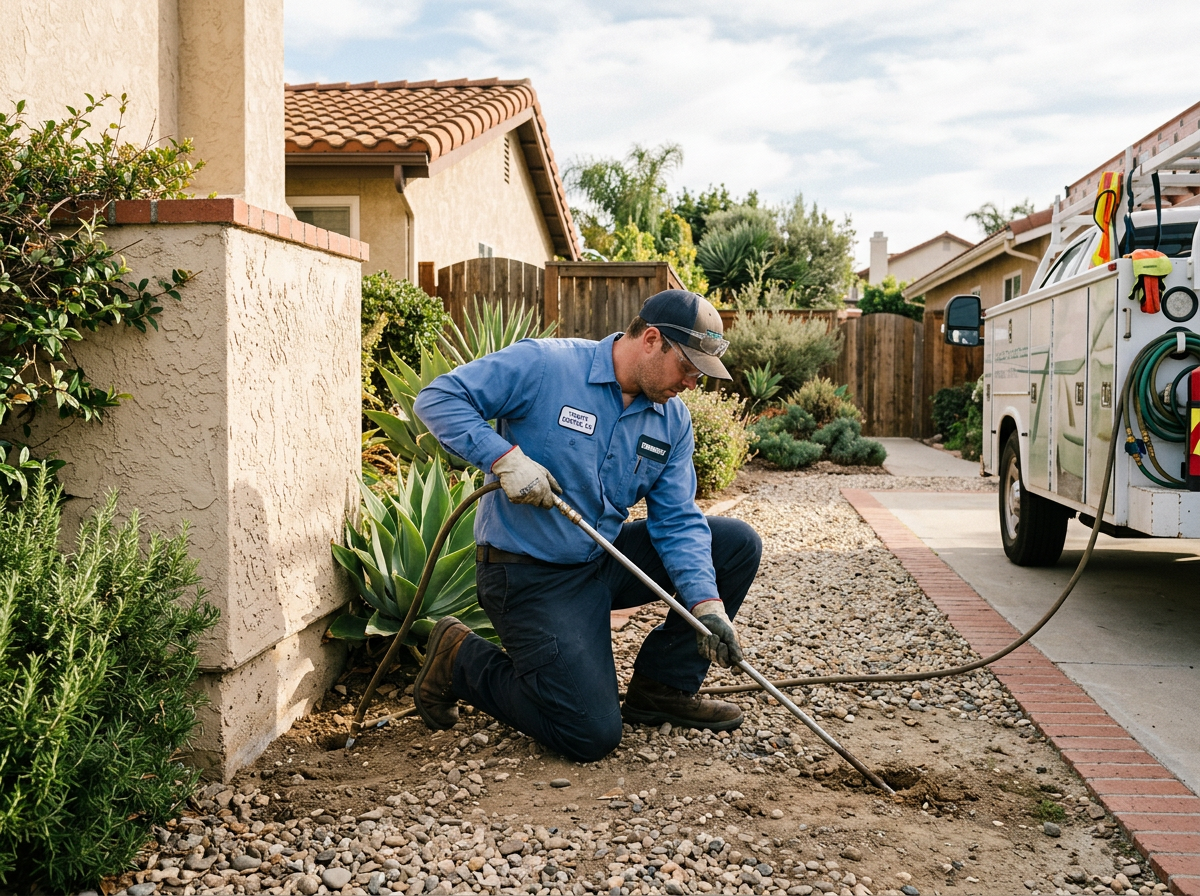
Technicians begin every job by examining crawl spaces, attics, garages, and exterior grade for evidence that separates the two types. Once the species is confirmed, treatment follows the biology: localized borate or foam applications for drywood colonies inside single members, or a continuous liquid barrier created by trenching and rodding around the entire foundation plus beneath slabs and additions for subterranean colonies. Gaps in any barrier allow re-entry within months.
Termite Control Near You — Choose Your City
Every city below has its own local Termite Control page with coverage details.
Mono County
Butte County
Kern
Fresno County
Plumas County
Kern County
Yuba County
Inyo County
Placer County
Sutter
Tuolumne County
Tulare
Calaveras County
Mariposa
Alameda
Mariposa County
Amador County
Nevada County
Sierra County
Plumas
Riverside
San Bernardino County
Sonoma
San Diego County
Riverside County
Sonoma County
Marin County
Glenn County
San Bernardino
Los Angeles County
San Diego
Tulare County
Mendocino
Yolo County
Monterey County
Madera County
Foothill cabins on dirt crawl spaces with old-growth timbers sit empty for long periods, letting both types progress undetected until an escrow Section 1 report surfaces the issue. Effective control also requires correcting moisture sources and wood-to-soil contact that sustain subterranean activity. Follow-up inspections verify whether the initial treatment reached active galleries or whether additional access points were missed during the first visit.
Annual monitoring catches new activity before it spreads, particularly on vacant properties where owners cannot spot frass or tubes themselves. The work succeeds only when every accessible area receives consistent coverage and conducive conditions receive correction at the same time.
Technician insight
In Tehachapi the thing that catches most people out with Termite Control is the mix of drywood and subterranean activity on the same foothill lot. Cabins with dirt crawl spaces and old timber sit empty for months, so tubes and frass go unnoticed until an escrow report arrives. Treating only the obvious area without checking the full perimeter or correcting drainage almost always brings them back through the untreated gap.
Tehachapi Cabin Crawl Space Find
A vacant foothill cabin showed small frass piles near the garage but mud tubes along the north foundation. Inspection confirmed both drywood in rafters and subterranean activity under the slab addition. Spot treatment addressed the drywood while trenching and rodding created a continuous barrier around the entire perimeter and under the addition. Follow-up visits confirmed no new tubes or frass.
Termite Control Services We Offer
✓Species Identification Inspection
Technicians examine frass, mud tubes, kick-out holes, and wood damage to determine whether drywood or subterranean termites are present before any treatment begins.
✓Localised Spot Treatment
Borate or foam applications target drywood colonies inside individual wood members when evidence shows activity is limited to accessible areas.
✓Liquid Soil Barrier Installation
Trenching and rodding create a continuous treated zone around foundations, piers, and under slabs to interrupt subterranean termite access to moisture.
✓Baiting System Installation
Stations installed in soil around the structure allow ongoing monitoring and colony elimination for subterranean termites where liquid barriers are impractical.
✓Crawl Space Treatment
Foothill homes with dirt crawl spaces receive targeted inspection and treatment of piers, stem walls, and sill plates where both termite types commonly attack.
✓Conducive Conditions Correction
Technicians identify and document wood-to-soil contact, poor drainage, and moisture sources that allow subterranean termites to persist after initial treatment.
How it works
- 1
Detailed Property Inspection
Technicians inspect crawl spaces, attics, garages, and exterior foundations for frass, mud tubes, kick-out holes, and active galleries.
- 2
Species Confirmation
Evidence collected determines whether drywood or subterranean termites are present and selects the matching treatment method.
- 3
Treatment Application
Spot treatments, trenching and rodding, or bait stations are applied according to the species and extent of activity found.
- 4
Follow-Up Monitoring
Return visits verify results and address any new activity or areas missed during the initial application.
Pricing
Scope depends on structure size, species found, and access conditions. Call for an inspection-based quote.