
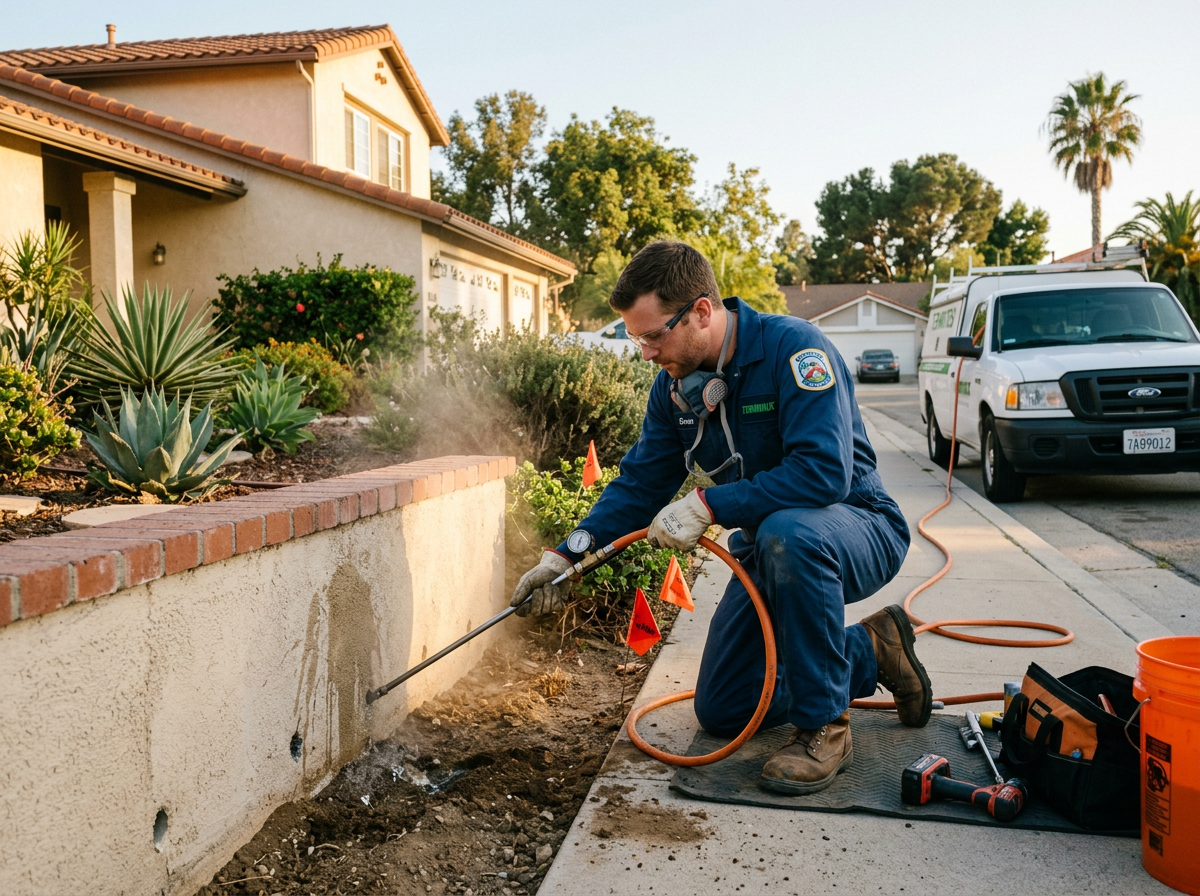
California properties face both drywood and subterranean termites, and the two demand entirely different treatments. Drywood colonies live inside structural wood with no soil contact, leaving frass pellets near kick-out holes, while subterranean colonies require constant soil moisture and build mud tubes along foundations. A technician must first confirm which species is active through visual inspection of galleries, frass, and tubes before choosing between localized wood treatments or soil barriers. Misidentification leads to repeated failures because a spot treatment will not reach a subterranean colony and a soil barrier will not affect drywood inside timbers.
In Tehachapi foothill homes with dirt crawl spaces and older timber construction, undetected activity often spreads during long vacancy periods. Technicians examine joists, piers, stem walls, and attic members for active signs rather than relying on seller statements. Once species is confirmed, treatment follows the biology: borate or foam applications for accessible drywood galleries, or continuous trenching and rodding for subterranean barriers beneath slabs and additions. Gaps in any barrier or untreated wood sections allow re-entry, which is why full access and complete coverage matter more than product choice.
Termite Treatment Near You — Choose Your City
Every city below has its own local Termite Treatment page with coverage details.
Mono County
Butte County
Kern
Fresno County
Plumas County
Kern County
Yuba County
Inyo County
Placer County
Sutter
Tuolumne County
Tulare
Calaveras County
Mariposa
Alameda
Mariposa County
Amador County
Nevada County
Sierra County
Plumas
Riverside
San Bernardino County
Sonoma
San Diego County
Riverside County
Sonoma County
Marin County
Glenn County
San Bernardino
Los Angeles County
San Diego
Tulare County
Mendocino
Yolo County
Monterey County
Madera County
Escrow-triggered Section 1 reports frequently prompt calls in this region. The inspection covers crawl spaces, garages, and exterior grade conditions that commonly allow entry in older cabins. Treatment plans are scoped only after mapping all active areas, and follow-up visits verify whether the chosen method reached every colony. Homeowners who skip the initial identification step or limit access to certain rooms often see activity return within the same season.
Technician insight
In Tehachapi the thing that catches most people out with Termite Treatment is assuming the same method works on every job. Foothill cabins on dirt crawl spaces with old-growth timber often have drywood in the attic while subterranean activity runs along the stem walls below, and missing either one means the job fails. We see it every time a seller skips the crawl space during an escrow inspection.
Tehachapi Cabin with Mixed Activity
The homeowner noticed frass near a bedroom window but no tubes outside. Inspection revealed drywood galleries in the attic rafters and mud tubes along the crawl space piers. Localized borate treatment addressed the drywood while a continuous soil barrier was installed around the perimeter. Follow-up confirmed no new frass or tubes after six months.
Termite Treatment Services We Offer
✓Species Identification Inspection
Technicians examine frass, mud tubes, galleries, and kick-out holes throughout the structure to determine whether drywood or subterranean termites are present before any treatment plan is created.
✓Localised Spot Treatment
Accessible drywood galleries receive targeted borate or foam applications directly into the wood members where colonies are confirmed, avoiding unnecessary whole-structure work when activity is limited.
✓Liquid Soil Barrier
A continuous trench is created around the foundation with rodding beneath slabs and additions to establish a soil treatment zone that interrupts subterranean termite access to the structure.
✓Baiting System Installation
Monitored bait stations are placed in the soil at intervals around the perimeter, allowing ongoing colony suppression for properties where trenching access is restricted or long-term monitoring is preferred.
✓Crawl Space Treatment
Dirt crawl spaces common in Tehachapi cabins receive thorough inspection and targeted barrier or wood treatment to address both species in areas that remain vacant for months.
✓Conducive Conditions Correction
Wood-to-soil contact, poor drainage, and debris under structures are identified and addressed to reduce future termite pressure after the initial treatment is complete.
How it works
- 1
Initial Species Inspection
A technician inspects crawl spaces, attics, foundations, and exterior for frass, mud tubes, and galleries to confirm which termite type is active.
- 2
Treatment Plan Development
Based on findings, the correct method is selected: localized wood treatment for drywood or continuous soil barrier for subterranean activity.
- 3
Application and Access Work
Technicians complete trenching, rodding, or direct wood treatments, ensuring every identified active area receives full coverage.
- 4
Follow-Up Verification
Return visits confirm treatment effectiveness and check for any new activity that may require additional targeted work.
Pricing
Scope depends on structure size, species present, and access conditions; pricing is provided after the inspection. Call to schedule.